Wednesday, October 24, 2012

The American Swedish Historical Museum


So, apparently there's a really large lake in the middle of South Philadelphia.  It's amazing the things you can find when you actually venture outside of the house!  Or west of Broad Street...that's a place I've deemed a "Red Zone" and therefore stay out of...(to be fair, the lake isn't in a red zone, but Point Breeze has pretty much jaded my entire view of everything west of Broad....)

Anyway, next to the huge lake full of ducks, geese, and a couple swans is the American Swedish Historical museum - a great museum about a group of people that is widely overlooked in the historical documentation of Philadelphia and in American history.

For this blog, I have chosen a piece from the new Swedish American Line exhibition.


This exhibition is a collection of items and artifacts from the ships that became the main route and from the United States by many Swedish citizens.  In particular, I have chosen the wall display of three large crowns.


This exhibit is entitled "Three Crowns" and is made of painted metal and gold gilt.  These particular crowns adorned the smoke stack of the MS Gripsholm, one of the ships in the Swedish American fleet, in the 1950s.  The crown was a symbol of the fleet and can be seen on all souvenirs and dinnerware used on the ships.

These crowns were originally a very important detail on the ship.  They were visible from miles away and identified the ships as part of the Swedish American fleet.  Now, these large crowns fill a wall of the exhibition space.  Their shiny gold coating, a detail that may not have been appreciated while hung atop massive smoke stacks, reinforces the idea opulence and wealth that was found throughout the ships.  They are of particular importance to those who remember traveling on the Swedish American Lines or had family that used the lines.

These three crowns are on display at the beginning of the display as a welcome into the exhibition, just like they would have been one of the first things visible as the ship approached port.

The crowns were acquired as part of the collection from Torsten Torstensson.  Torstensson has the most extensive collection of Swedish American Line artifacts and loaned the entire collection to the American Swedish Historical Museum with the stipulation that all artifacts be on display.


Initially, the crowns were intended to be displayed on an eight foot wall as visitors entered the exhibition space.  When the collection arrived, however, it was discovered that the crowns were much larger than previously thought.  They were instead hung on the first main wall as visitors enter and turn to the right into the room.  They are arranged in the same way they were arranged on the smokestacks of the ships.

There is a small label placed next to the crowns.


The label offers a brief description of crowns and why they are significant to the ship.  The text on this panel describes the crowns as "beautiful" and is phrased to remind viewers that the ships were extravagant and admired by many.

Other nearby objects are dinnerware and souvenirs from suites on the ships.  All of these artifacts are decorated with these crowns.  They reinforce the importance of the crowns as symbols of the Swedish American Line.


A knowledge of Swedish culture in America would help with the understanding of the three crowns as well as the entire collection.  Additionally, the crowns may be of interest to those with an interest in the history of ships and cruise lines. An understanding of immigration routes would also make this exhibit more interesting.

The Three Crowns may not be interesting to those who are more focused on the artifacts and objects that were accessible and actually used by passengers.  Things like the complimentary ash trays and spoons might be more interesting.  Visitors looking for a personal narrative from passengers on the ship may not be able to connect with the crowns. 


The crowns are a sign of wealth and extravagance which the museum portrays as a positive experience.  A differing viewpoint could be that the unnecessary usage of gilded crowns on smoke stacks is a wasteful display of wealth.  Additionally, these crowns were aboard the Gripsholm which launched a year after Stockholm, another Swedish American Line ship, collided with Andrea, an Italian ship, resulting in the death of about 51 people. (http://www.salship.se/dawe/dawe_collision_1.asp)  This extravagance could have been perceived as insensitive to those lost in the disaster.


It would be helpful for viewers to be able to see how the crowns were displayed on the ships smokestacks.  Images of the smokestacks could be usesful for this.  These crowns could also be used as a sense of scale for the entire ship.  This could be done by painting a life size smokestack behind the crowns on the wall with a scale model of the ship or ships placed below.  Additionally, comparing the crowns across the Swedish American Line would provide viewers with more information.


Wednesday, October 17, 2012

ZOMG THE ZOO!!!!!!

We went to the zoo!!!! The Philadelphia Zoo!!!!

Best. Day. Ever.

I love zoos. So much.  Animals are just about the coolest thing ever invented.  Going to the zoo, I was happier than this llama
and more excited than this little dude is about these flowers


Especially when I found out the Philadelphia Zoo has one of the greatest animals ever created...the Okapi!!!!


The okapi is this awesome animal.  Describing an okapi much like that song from Pete's Dragon..."He has the head of a camel, the neck of a crocodile...It sounds rather strange..."  (It's So Easy).  Though it is most closely related to the giraffe, the okapi has the stripes of a zebra, the body of a horse, and the head of a giraffe.  Due to its awesome nature, I have chosen it as my object for this week. 

You talkin' bout me?!

Once again, this is the Okapi.  A fabulous animal from the forests of Democratic Republic of the Congo in Africa.  It is the giraffe's only living relative and lives a solitary life in the rain forest.

I may be biased, but the Okapi should be important to everyone in the entire world.  It may be of particular interest to those interested in giraffes as these are close relatives.  The okapi is also important to those wishing to learn about and to teach about conservation efforts in the Congo where they are threatened by habitat destruction and poaching.  (Of course, those with an interest in weird looking animals might also find the okapi to be important and interesting!)


The Philadelphia Zoo houses their okapi to teach the public about the importance of conservation.  Without protection, species like the okapi could become extinct.  For visitors of the zoo, being able to see animals that are threatened will form a connection that may inspire them to become active in conservation efforts.  Additionally, okapi live in dense rain forests and studying them in the wild is often difficult.  Being able to study okapi in captivity can be very helpful for the survival of the species.

At the Philadelphia Zoo, the okapi can be found next to the Red River Hog in a quiet section of the grounds.  It lives by itself, just as okapi are solitary in the wild.  Its enclosure includes grass without much other vegetation.  It is also far from most other African mammals and, aside from the hog in the next enclosure over, is actually quite far from any other animals.

There are two display panels that give information regarding this fabulous creature.  One gives basic information about the okapi (see above picture).  The other offers information regarding the lifestyle of the okapi.


Unfortunately, these signs do not offer much in depth information about the okapi.  The basic information is very short and does not give many details regarding the status of the species and how conservation efforts may be helping the okapi survive.

As stated before, the okapi is next to the Red River Hog.  The only similarity between the okapi and the hog are that they both live in Africa (the Red River Hog is found in most parts of Africa).  The hogs gather in large numbers and are nocturnal while the okapi are mostly solitary and are diurnal.  The Red River Hog is also of Least Concern in terms of conservation efforts while okapi are Threatened.  The Red River hog therefore does not offer much in terms of helping to understand the okapi.  Nor does the giant channel 6 news balloon or the empty field and stage.  I believe the okapi could benefit from some added surroundings that relate to animals in the African congo or species facing the same threats as the okapi.

A background in biology or in animals would greatly help one's understanding of the okapi.  The okapi has many unique features such as the long blue colored tongue like the giraffe and a velvety yet oily coat.  Knowing these facts would help any viewer appreciate the uniqueness of the okapi.  

I can't imagine anyone not being interested in this awesome animal but, if I had to choose a group, it would be people that have not heard of such a creature.  While glancing at a map, visitors may be more inclined to head towards the animals with which they are more familiar, such as lions or zebra.  The okapi also doesn't have the cute face that a leopard has or the quirky personality of a lemur or orangutan, which may lead to some visitors being less interested in the okapi. (Those visitors, however, would be very sad people!)


While used to promote conservation in this setting, the okapi could also be used to display advances in information and research.  Much of the information known about okapi has been only recently gathered.  They have been notoriously difficult to trace in the wild since they live in such a remote and dense environment.  Therefore, any information learned could be seen as an advancement in the field of research and science.


Other experiences could be created to help visitors understand more about the okapi.  One idea could involve flip panels that highlight the unique physical characteristics of the animal and how those adaptations help the okapi survive in its environment.  Additionally, a description of the other animals found in the rain forest with the okapi that are also threatened could be beneficial to the understanding of okapi.


I encourage you to learn all you can about the extraordinary animal.  I mean, come on, look how cool it is!!!


A newborn from the Denver Zoo http://www.zooborns.com/zooborns/okapi/


Learn more about the okapi from the Philadelphia Zoo here! (You can even adopt the zoo's okapi!)

Wednesday, October 10, 2012

The Rosenbach


The Rosenbach Museum has a large collection of rare books, manuscripts, drawings, and other artifacts.  Choosing an object to write about for this blog, however, was very difficult.  Most of the objects at the Rosenbach are not available for immediate viewing and examination as the books and manuscripts require a very careful handling.  My choice for this blog is based on a quote from our tour of the Rosenbach – “Books are a very democratic object.”  This was meant to explain that the influence a book or story has is left in the hands of the public and not necessarily the author.  The best example of this is with the James Joyce’s original manuscript of Ulysses.

Title: Ulysses
Year: 1917
Material:  Ink and paper               
Creator: James Joyce
Collection:  Literature
James Joyce’s Ulysses is often referred to as one of the greatest novels in history.  The Rosenbach has the original hand written manuscript of this novel.  Currently on view is the “Circe” episode which Joyce began writing in 1920.  He claimed to have written this episode at least five times before finalizing this draft in December of 1920.

Image from www.rosenbach.org

 This manuscript is important to all Joyce fans and those with an interest in English literature and 20th century literature.  

Portions of the manuscript are always on display at the Rosenbach.  The episodes which are on display are in a constant rotation for preservation purposes.

Dr. Rosenbach originally owned a first edition copy of Ulysses, which, at the time, was banned due to obscenities.  He later purchased the manuscript in 1924 from a lawyer who had defended Joyce and his publishers from the obscenity charges under Comstock laws.  

Image from: http://travel2.nytimes.com/2006/03/31/travel/escapes/31trip.html
Due to the delicate nature of paper and its sensitivity to light, only portions of the manuscript may be on display at a time.  These pages are under a glass case in a room that is only accessible with a museum guide.  The case is covered from light when visitors are not viewing the pages.  Additionally, a portion of the manuscript is on display adjacent to the manuscript of Stephen Colbert’s book I am a Pole, and So Can You!  There are a few small plaques near the manuscript that offer some descriptions of the significance of the particular pages on display.

The label for the manuscript points viewers to the differences between the manuscript and the final printed copy.  The labels do not seek to give the viewer a particular point of view or opinion of the manuscript, but just to offer information.

Other objects in the exhibition space include the original notes from Dracula and other books.  These manuscripts add to the appreciation of the hand written copy of the texts.  There are also thousands of books on shelves surrounding the manuscript.  These books serve as a visual representation of other works that have been influenced by Ulysses.

Knowledge of the book and its impact on literature in the 20th century, or even Joyce’s other works would assist with the understanding of this manuscript.  An appreciation for English or 20th century literature would enhance the appreciation of this manuscript.

This manuscript may not be interesting to visitors who have no knowledge of English literature.  Young children and those to whom reading is a chore may not enjoy or appreciate viewing the manuscript.  Additionally, the way the manuscript is presented may not be interesting to some viewers.  There is no way for viewers to interact with the manuscript.  If they do not know the story of Ulysses, the only way for the viewer to gain context is to read the writing on the manuscript, which is often not legible.  These factors may make the manuscript not as interesting as it could or should be.

Aside from the importance to the story, the manuscript provides a narrative for how books can be democratic objects.  In the final version of the book, the “word known to all men” is not included.  It is, however, present in the manuscript.  This manuscript version of the story was not seen by the public and therefore the public was allowed to decide what Joyce intended the answer to be. 
Similar to this representation of books as democratic objects is the nearby collection of Romeo and Juliet stories.  The original story by Shakespeare was given to the public who then interpreted the story in a number of different ways, including versions in which both characters live happily ever after.

A side to side comparison of the final printed copy and the manuscript would create a different experience for the viewer.  Viewers would then not have to rely on their own knowledge of the book to connect with the information.  Similarly, an audio/visual interactive could allow visitors to connect with the manuscript different way than just viewing the pages from behind glass. 

Tuesday, October 2, 2012

The National Constitution Center


The National Constitution Center is located directly across from Independence Hall.  From inside the very modern looking Indiana limestone and glass building, visitors look across Independence mall at the brick building where the document that inspired the NCC was actually signed.  NCC has decided to approach their site in a way that is different from most museums.  They focus more on the concept of the Constitution rather than on the actual paper document.  Exhibitions are related to the concepts found in the Constitution of the United States including an emphasis on voting rights and a soon-to-open exhibit about Prohibition.  Because of this departure from an object-centered approach, the artifact collection of NCC is limited. For this blog, I have chosen to write about one of the many interactive found in the main exhibition are.


 “Discover Your Presidential Candidate Match” was installed as a way to promote active citizenship.  Visitors enter a mock voting booth, complete with curtains to shield the visitors’ responses, and answer questions regarding social issues that they find most important on a touch screen.  Their answers to these questions match them with the candidate that holds similar views.  The installation was created to coincide with the 2012 presidential election.
  

This object is important to a variety of people.   Each topic chosen offers a variety of possible viewpoints.  For example, if a visitor selects “Immigration” as an important issue, one questioned asked will be to tell if they Strongly Agree, Agree, Disagree, or Strongly Disagree with the statement “Illegal or undocumented immigrants may not claim any financial benefits from the government.”  At the bottom of the screen are descriptions of what an opposing or agreeing viewpoint might be.  Young people and visitors that are uninformed about political issues may find this exhibit interesting.  They can learn about the candidates and the differing viewpoints of important issues.  Young people that are too young to vote may also find this exhibit interesting.  They get a real voting experience and learn about issues effecting the presidential election. 


This display exists to educate visitors about the candidates in this year’s presidential election.  Additionally, the museum is promoting active citizenship and promoting visitors to exercise their right to vote.  It was placed here to coincide with the current presidential election.

This display is in the inner middle ring of the NCC’s main exhibition hall.
  This inner ring is meant to promote active citizenship and community involvement. It is near other exhibits that also pertain to voting.  Also nearby is a podium where visitors can pretend to be sworn is as the president of the United States.

The labeling surrounding the “Discovering Your Presidential Candidate Match” is politically very neutral.
  The text encourages visitors to use the exhibit to learn about the candidates and issues that are important to them.
Near this exhibit is a timeline of constitutional amendments. Included in this is an interactive informing visitors if they would have been able to vote in different time periods.  The realization that many visitors did not gain the right to vote until many years after the constitution was originally drafted could lead to a better understanding and appreciation for the “Discovering…” exhibit as well as voting in general. 
And interest in politics and political issues might further one’s interest in this particular display.  Those that are not knowledgeable in political issues may also find this exhibit interesting because they will be able to learn from it.
This may not be interesting to those that are well informed in politics.  Additionally, it may not be interesting to those that have very little interest in political issues.

International visitors from countries that do not have the same voting rights as American citizens may have a different viewpoint of this object.
  They may not understand completely the ability to choose a candidate based on their personal viewpoints of political issues.

Other experiences to engage visitors could include videos of debates from politicians about important issues.
  An interactive that asks visitors to deeply explore political issues in a mock-debate with other visitors or computer generated arguments from politicians may also help create an experience for visitors.

Overall, I had a great time at the National Constitution Center.  I cannot wait to return and see the Prohibition exhibit!  And, after signing the Constitution in a hall surrounded by statues of the men that created the Constitution, and receiving my own copy of the Constitution that now resides in my wallet, I feel like an expert  on the U.S. Constitution!

Tuesday, September 25, 2012

Philadelphia Museum of Art


Okay. I have a confession to make. I’m not a big fan of art museums. They’re often so cold and confusing. The stark white walls with paintings and sculptures that, most of the time, I can’t figure out.


So I can’t say that our trip to the Philadelphia Museum of Art was the trip I was most eager to take. It was, however, a pleasant surprise! I didn’t feel lost in front of paintings of abstract concepts wondering what the artist intended for me to think or feel.  For the first time, thanks to our amazing guide, I felt comfortable and actually enjoyed standing in front of a painting and observing the details I wouldn’t have normally noticed. I even found one object in the museum that I wish I could hang on my wall at home.  It is a lithograph called “The Wonder” by John E. Dowell (2001), printed by Robert W. Franklin, and is presented as part of the Full Spectrum: Prints from the Brandywine Workshop exhibit.


This is number twelve of forty off-set lithographs printed. John Dowell uses images from nature, in this case an ocean and cliff scene, to “heighten the viewer’s sense of humanity” and “trigger moments of reflection and personal memories.” 


There is a label with a short description of the artist on the wall next to the print. The text mentions that the artist, John Dowell, uses symbolism and nature to trigger moments of reflection.  As a viewer looks at this print, they are guided by this text to reflect on their experiences and how they connect with the images in the artwork.  

In this particular print, the color teal provides a backdrop for a blue-hued heart with pink flourishes decorating each side. An image of the ocean and sky are placed in the center, rendering the heart broken.

This is one of many heart prints that Dowell has created. This particular heart, however, is the only one that appears to be a broken heart. This print is an important part of the Brandywine exhibition as it is a unique perspective of a landscape. Additionally, the broken heart serves as a tribute to the PMA’s late director Anne d'Harnoncourt. It was one of one hundred prints donated by the Brandywine Workshop in her memory.


This print is displayed on a wall near the other prints from the Brandywine Workshop. It is on a white wall inside a white box frame, elevating the glass from the print.  The white surroundings accentuate the colors found in the print.

Nearby items are other prints from the Brandywine Workshop. The topics of the surrounding pieces highly varied.  A nearby wall contains prints with political messages; another contains prints with depictions of American locales.  While these topics do not relate directly to the print I have chosen to write about, they prime the viewer to begin thinking about the messages intended by the artists.

A better understanding of offset lithography and techniques used to create lithographic prints would enrich my understanding of Dowell’s work. Additionally, the personal history of Dowell could lead to an understanding of the experiences that have shaped his perception of nature and spiritualism.

This object may not be appealing to those interested in photographs or paintings on canvas. This piece is very introspective and may be most appealing to those wishing to analyze the thoughts of the artist as opposed to reflecting upon their  feelings and memories.

I viewed this piece as a broken heart but this may not be the case for all viewers.  Some viewers may only see the peaceful ocean scene set inside the heart.  Others may focus on the way the pink flowers adorn the cliffs.  

Viewers could be better engaged with this particular piece if it were surrounded by the entire Heart collection. The viewer would be able to compare and contrast each of the pieces Dowell has created and, from them, experience a range of emotions and memories. 

John E. Dowell's complete Heart collection can be found here and the prints from Full Spectrum: Prints from the Brandywine Workshop can be seen here.


Wednesday, September 19, 2012

Eastern State Penitentiary

I've been in Philly for just a few days over a month! And somehow I've managed to survive! I've adjusted well, I think. I've learned how to use public transportation, acquired a taste for Yuengling Lager, and how to stretch any meal into two! ($5 footlong = two days of eating!)  But of course homesickness creeps in every once in a while.

Fortunately, last week we visited a site that reminded me of home. The Eastern State Penitentiary!!


Perhaps I should clarify that I am from Chino...a small city outside of Los Angeles made "famous" by movies and television shows such as "The Big Lebowski", "The Simpsons", and "The O.C." - which all reference the city's most notable attraction, The California Institution for Men.  I used to pass by the prison on my way to work every day and, while growing up, I would frequently see the prisoners riding around in their big green prison bus on their way to their daily community service obligations.

So, for me, visiting an old prison was like visiting home!!!! Okay, not really, but I at least had a strange sort of connection to the place!

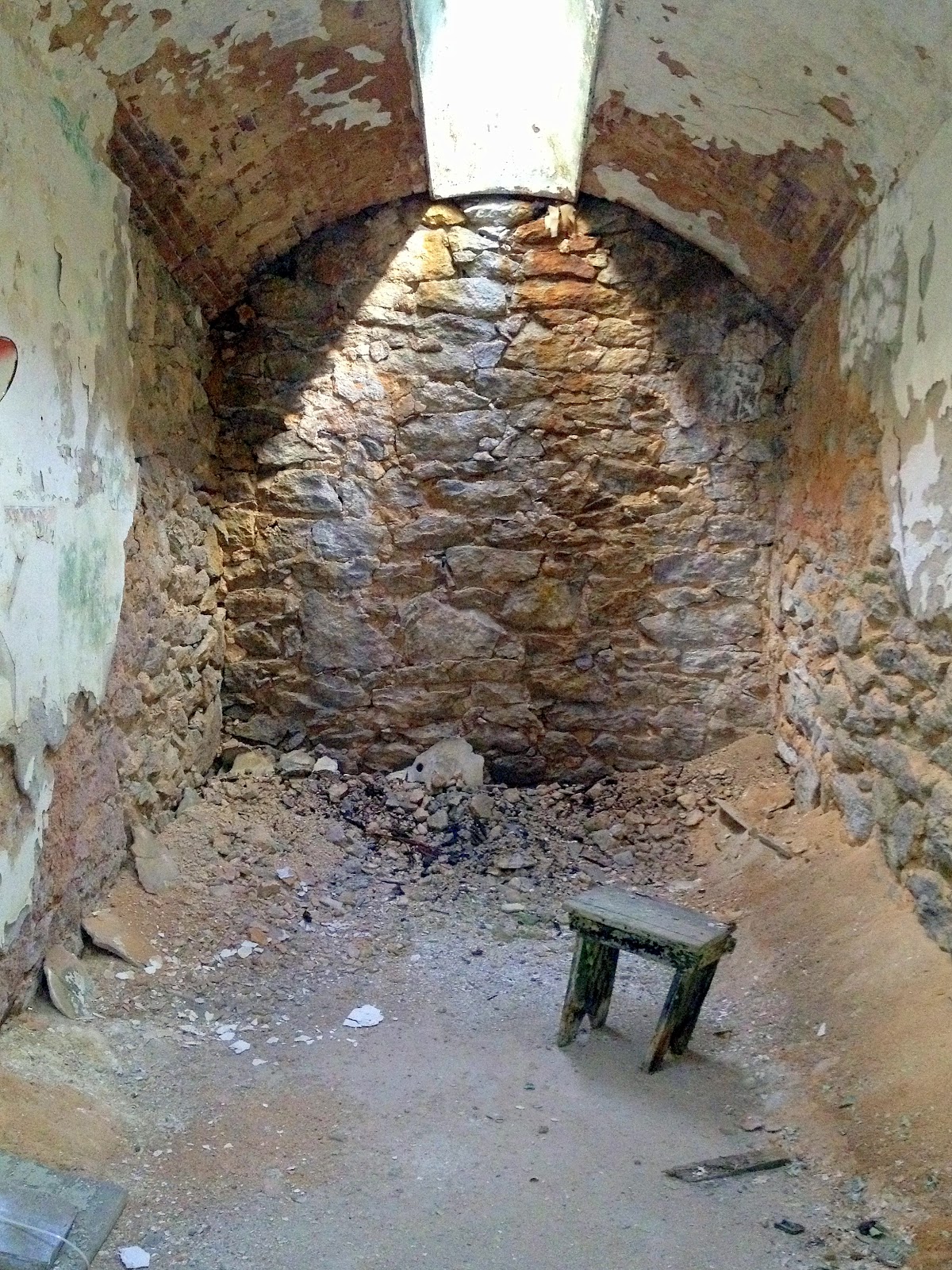
My favorite object from this place is one that I feel perfectly embodies the structure's classification as "stabilized ruins."  My "object" is a stool (or is that a table?) in one of the crumbling cells.


I like to call this piece "Stool or Table - Stabilized Ruin." I suppose this installation was first created shortly before the Period of Abandonment began in 1971 and was finally completed 40 years later when the years of neglect and weathering left the stool in it's current state.  I suppose Mother Nature can be credited as the creator of this piece.

There are several unique things about this object.  The stool sits in the middle near the center of the cell, just where the pile of rubble from the crumbling walls and ceiling ends.  The paint on the walls is flaking off, exposing the brick structure and the small skylight in the ceiling provides most of the light into the cell.  The stool itself mimics the crumbling paint of the walls surrounding it and is leaning to the right, looking as if it may fall at any moment - It's barely stabilized and is in ruin.

This object is on display here as part of the Eastern State Penitentiary's intention of showing the building in it's current state and not a completely refurbished and refined location.  There is no label or description of this object; it's just another one of the many cells visitors walk by.  As stated previously, the stool is surrounded by the crumbling room and debris from the walls, ceiling, and other broken objects that may have been found in the cell after the Period of Abandonment ended and the penitentiary was opened to the public, which adds to the stool's depiction of ruins.  Without these surroundings, the stool is what most would consider a broken and useless object. 

An interest in history and architecture could help with the enjoyment of this still stool and room.  Those with little interest in historic institutions and buildings will most likely not be interested in this stool or the room in which it sits. Without the appreciation of the history of the Eastern State Penitentiary, the stool is just a broken thing sitting in a giant mess of a room.

Other viewers might find this particular stool in this cell interesting if images of the cell and stool in its pristine state are displayed near the cell that is now crumbling and falling to pieces.  Visitors might also be interested in knowing what the stool was used for by the prisoners that once resided there.

Overall, the Eastern State Penitentiary is a fabulous display of what happens when "modern" architecture is left to decay and is definitely worthy of a visit!

Tuesday, September 11, 2012

Objection One...My Favorite Object?


Initially, as I sat down to write this blog about my favorite object, I thought of about a billion things that might be my favorite.


The jacket from my favorite drum corps, the marble and paper-clip necklace from when I aged out of Pacific Crest drum and bugle corps, the DVDs of my favorite movies (Breakfast at Tiffany’s and Casablanca), the star necklace I bought when visiting New York City with my best friend, my phone that keeps me connected to all the information and people I want, my laptop that connects me to the interwebz and has my extensive music collection, the Red Sox jacket with “The Rocket” embroidered on the front that I stole from my brother, the collection of concert tickets, wristbands, and House of Blues VIP passes, the nametag from when I worked at Disneyland, the glowing bracelet from the OK Go music video….but something happens when you suddenly find yourself in unfamiliar territory 3,500 miles away from home.  When one is forced to cram all of their personal belongings into two suitcases, weighing less than fifty pounds each, and one carry-on with no liquids or sharp objects, the dependence upon objects becomes diminished.  Likewise, when one is forced to say goodbye to family, friends, and a lifestyle to which one has been familiar for over a quarter of a decade objects seem much less important.  On those nights when Philly starts to feel like less like a new home and more like Hoth, I don’t think to myself, “Golly gee damn, I miss that empty bottle of Sky Dog wine from the Oliver Winery” or “I’d be much happier if I just had that Zenyatta bobble-head from Santa Anita.” What I really want are the people and experiences I’ve left behind.  The nights arguing with the bartenders about cheeseburgers with The Vegan, The Band Director, and The Old Guy (those are my friends, by the way), the shopping trips with Mom where I’d always convince her to buy me some dress that I didn’t need, and the awkward nights at The Yardhouse with my Pie Hell people.  It is for this reason that this blog is not necessarily about an object.  It’s about someone.  Someone I miss, possibly, the most.  This person is my niece, Allysaurus. 


Allysaurus was born November 11, 2009.  November 12th is when I actually learned she existed.  Mom called me, said she had important news and asked me to meet her for breakfast at Farmer Boys. (I was hoping she’d buy me food but a niece is good, too)  It had been years since I had seen my brother; he only crossed my mind when I took his Red Sox jacket out of the closet.  He hadn’t told anyone about his daughter until the day after she was born.  It was a few months before Mom and I actually met Allysaurus and Holy Geez was that baby adorable.


It’s hard to put a person on display but I’ve done a fairly good job at doing so.  Currently, pictures of her adorn the mirror in my room in Philly as well as my facebook page.  I keep her pictures out in places where I know I will see them every day.  She is a reminder to stay motivated. I would like her to grow up and think “Wow! My auntie Yay-yuh (She can’t exactly say my name yet) is the coolest auntie ever!”  I like to think that I can influence her to grow up into a remarkably intelligent human.  As it is, she has an interest in dinosaurs (one of her favorite movies to watch with me was The Land Before Time and I even took her to a museum in Los Angeles and bought her a stuffed blue dinosaur that she named Bluh-bluh), her favorite stuffed animal at my house was an Okapi (seriously, what kid, other than one partially related to me, knows and likes Okapi?!), and she has a strange fondness for rocks that I also had as a child.  I’d say I’m doing pretty well in the Influential Auntie role….though, that’s becoming difficult from the other side of the country.
If one considers the pictures on my mirror a form of display, then nearby “displays” would include other pictures of friends and loved ones.  These people are also important individuals that have helped shape me into the person I am today and that I enjoy thinking about and seeing every time I walk into my room.  
It’s difficult to say what field of study might enrich my understanding or exploration of this “object.”  I suppose a more thorough knowledge of developmental psychology may help me understand how her tiny brain is working and forming…allowing me to influence her in the best way at the most opportune times.
I can’t imagine anyone NOT being interested in this adorable object.  I mean, I don’t even like babies or non-adults (to be fair, there are quite a few adults I don’t like, either) and I freaking LOVE this kid...ever since the first time we picked her up and she gave us that weird pouty-lipped smile and looked up at us with her eyes that I swear are the darkest brown to ever exist.  I suppose others might say she’s just another little kid that cries at everything with hardly any civilized human qualities.  To those critics I say, “Yeah! But she’s so cute!” I mean, really. Adorable.  How can you not love a kid that, for a while, couldn’t quite produce that “v” sound so that “I love you” became “I lom you!”  The last time we had a party at our house that she came to, she conned almost everyone there into giving her a dinosaur cookie just by batting her eyes at them!  Seriously cute.
Favorite Object Honorable Mentions:
New Nephew (left); Riley, my dog (right)

The Vegan. Not pictured: The Band Director, The Old Guy